Smart Ways to Grow Your Local Business Online and Offline
Discover smart ways to grow your local business online and offline using Local SEO, Google Business Profile, social media, WhatsApp marketing, AI automation, customer reviews, networking, referrals, partnerships, and ...
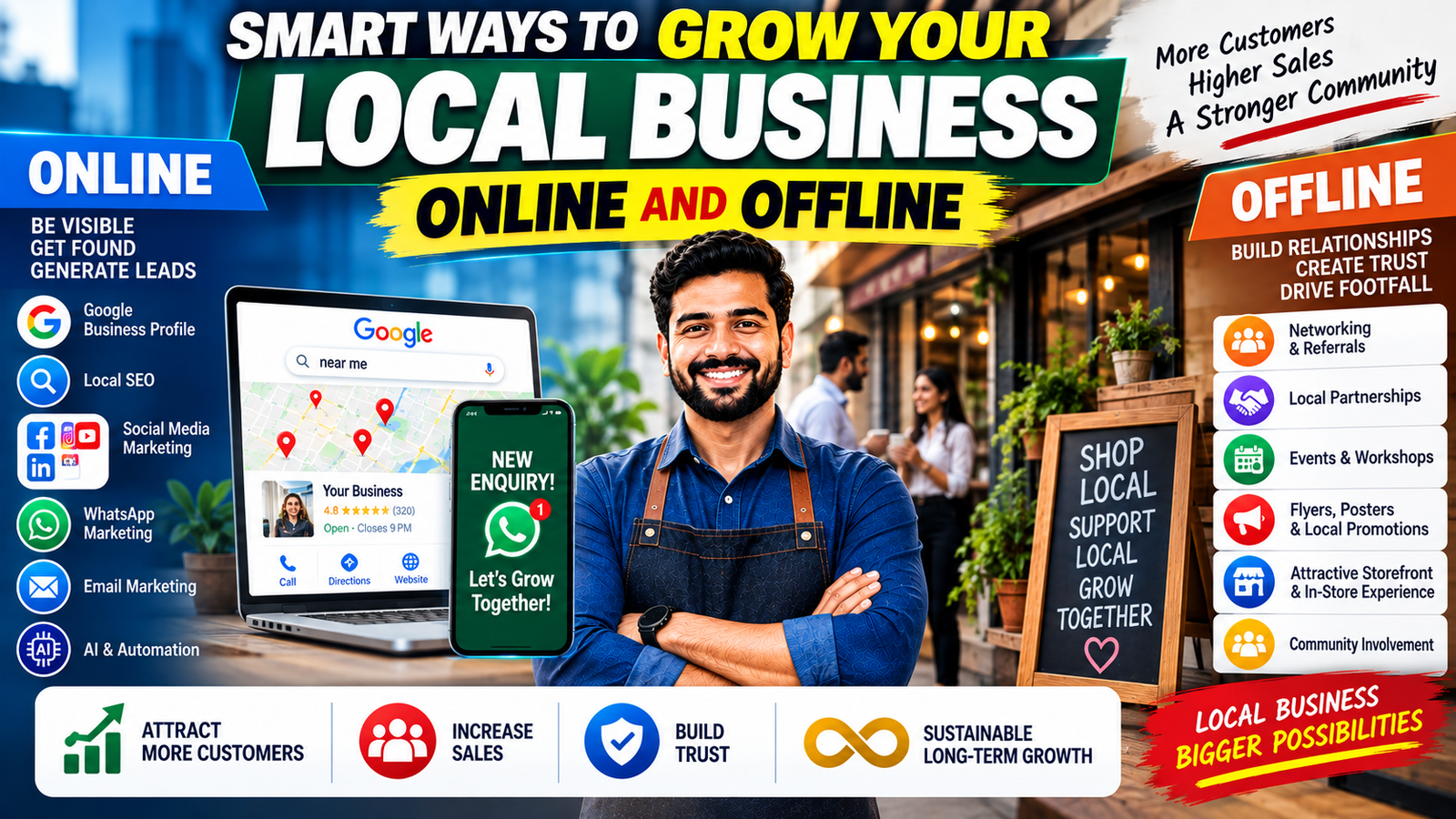
Smart Ways to Grow Your Local Business Online and Offline
Growing a local business today requires more than simply opening a store, providing a good service, or running advertisements.
Customers move between the online and offline worlds constantly.
They may discover your business on Google, check your reviews, visit your Instagram page, send you a WhatsApp message, visit your physical location, purchase your service, and later recommend you to a friend.
That means successful local business growth should connect both sides:
Online Visibility + Offline Relationships = Stronger Local Business Growth
Whether you run a retail store, restaurant, salon, clinic, real estate company, hotel, gym, repair center, consultancy, training institute, or professional service business, combining digital marketing with strong local relationships can help you attract more customers and build sustainable growth.
1. Understand Your Local Customer
Before investing in marketing, understand exactly who you want to attract.
Identify:
Customer location
Age group
Needs
Problems
Budget
Buying behavior
Preferred communication channels
Common questions
Purchase objections
Reasons they choose competitors
Create a simple ideal customer profile.
For example:
Customer: Local homeowner
Need: Home renovation
Location: Within 15 km
Main concerns: Price, quality, trust and completion time
Discovery channels: Google, referrals and social media
Preferred communication: Phone and WhatsApp
Knowing your customer helps you decide where and how to market your business.
2. Optimize Your Google Business Profile
For many local businesses, Google Search and Google Maps are important discovery channels.
Keep your Google Business Profile complete and accurate.
Add:
Business name
Correct category
Address
Phone number
Website
Business hours
Products
Services
Photos
Videos
Regularly update your profile when business information changes.
A strong profile can help potential customers understand your business and decide whether to call, visit, request directions, or view your website.
3. Improve Your Local SEO
Local SEO helps people searching for products and services in your area discover your business online.
Customers might search:
“Coffee shop near me”
“Best salon in Bangalore”
“Real estate agent near me”
“Website development company in Bangalore”
“Dental clinic near me”
Create useful website pages around the services and geographic areas you genuinely serve.
Optimize:
Page titles
Meta descriptions
Headings
Service pages
Location pages
Internal links
Images
Contact information
Also publish useful articles answering local customer questions.
Your goal should be to attract relevant visitors who could realistically become customers.
4. Build a Website That Converts Visitors into Leads
Your website should not function only as an online brochure.
It should help generate enquiries.
Customers should quickly understand:
What do you offer?
Who do you serve?
Where do you operate?
Why should they choose you?
How can they contact you?
Use strong calls to action:
Call Now
WhatsApp Us
Book an Appointment
Get a Quote
Request a Consultation
Also include:
Products and services
Testimonials
Reviews
Previous projects
FAQs
Contact details
Enquiry forms
Location information
Make sure the website works well on mobile devices.
5. Generate Genuine Customer Reviews
Customer reviews connect online reputation with offline customer experience.
After successfully serving a customer, ask for genuine feedback.
You can request reviews using:
WhatsApp
SMS
Email
QR codes
Receipts
Thank-you messages
Place a review QR code at your:
Billing counter
Reception
Office
Restaurant table
Service desk
Event booth
This makes it easier for satisfied customers to leave feedback.
Respond professionally to reviews, including negative ones.
6. Use Social Media to Build a Local Community
Social media can help customers become familiar with your business before they buy.
Create content such as:
Customer stories
Product demonstrations
Before-and-after results
Educational tips
FAQs
Short videos
Behind-the-scenes content
Employee introductions
Offers
Events
Local stories
Whenever appropriate, connect your content to an action:
Call
Message
Book
Visit
Get Directions
Do not measure social media success only through likes and followers.
Measure enquiries and customers.
7. Turn WhatsApp into a Business Growth Channel
WhatsApp can connect your digital marketing with real customer conversations.
Use it for:
Enquiries
Product information
Quotations
Appointments
Order updates
Customer support
Follow-ups
Feedback
Review requests
For example:
Instagram → WhatsApp → Enquiry → Follow-Up → Store Visit → Purchase
or
Google → Website → WhatsApp → Consultation → Sale
Use templates and automation where appropriate, but keep important conversations personal.
8. Create Valuable Local Content
Useful content can help customers discover and trust your business.
Think about the questions people ask before purchasing.
A real estate company could publish:
“5 Documents to Check Before Buying a Plot.”
A salon could create:
“How to Choose the Right Hair Treatment.”
A restaurant could publish:
“Top Dishes to Try This Weekend.”
A software company could create:
“How Much Does a Business Website Cost?”
You can distribute the same core idea through:
Blog posts
Instagram
Facebook
LinkedIn
YouTube
WhatsApp
Email
One useful topic can become multiple pieces of content.
9. Run Smart Local Digital Advertising
Paid advertising can accelerate customer acquisition when you have a clear offer and conversion process.
Depending on your business, consider:
Search advertising
Social media advertising
Video advertising
Retargeting
Local awareness campaigns
Lead generation campaigns
Use geographic targeting carefully.
A neighborhood restaurant may need only a small radius.
A real estate company may target customers across a city or wider region.
Measure:
Ad Spend → Leads → Qualified Leads → Customers → Revenue
Avoid judging campaigns only by clicks or impressions.
10. Use AI to Improve Your Marketing
AI can help small businesses accomplish more with limited time and resources.
AI can assist with:
Content ideas
Social media captions
Blog drafts
Email drafts
Customer FAQs
Lead qualification
Follow-up messages
Review responses
Marketing analysis
Customer support
Sales assistance
For example:
Website Enquiry → AI Qualification → CRM → Salesperson → Follow-Up
AI should support employees, not replace genuine customer relationships.
Use automation for speed and humans for trust, expertise, empathy and negotiation.
11. Build an Offline Referral Network
Digital marketing is powerful, but referrals remain extremely valuable for many local businesses.
Build relationships with:
Existing customers
Suppliers
Business owners
Consultants
Professionals
Community leaders
Networking groups
Explain clearly:
Who is your ideal customer?
What problem do you solve?
What type of referral are you looking for?
The easier you make this to understand, the easier it becomes for someone to refer you.
12. Partner with Complementary Local Businesses
Look for businesses that serve the same customer without directly competing with you.
Examples:
Real Estate Agent + Home Loan Consultant
Gym + Nutritionist
Wedding Planner + Photographer
Hotel + Travel Agency
Interior Designer + Furniture Store
Website Developer + Digital Marketing Consultant
You can collaborate through:
Referrals
Joint offers
Events
Workshops
Content
Cross-promotion
Bundled packages
Good partnerships can create a steady stream of warm opportunities.
13. Attend Local Networking Events
Online marketing creates reach.
Face-to-face networking creates relationships.
Attend:
Business networking meetings
Trade associations
Exhibitions
Chamber events
Entrepreneur meetups
Community gatherings
Workshops
Industry events
Do not attend only to distribute business cards.
Build relationships.
Ask about other people's businesses and understand how you can help them.
Good networking is based on trust and consistency.
14. Conduct Workshops and Educational Events
Instead of always selling, teach something useful.
Examples:
A digital marketing company can conduct:
“How Local Businesses Can Generate Leads Online.”
A financial consultant can conduct:
“Financial Planning for Small Business Owners.”
A real estate company can conduct:
“First-Time Property Buyer Workshop.”
A fitness center can organize:
“Healthy Lifestyle Awareness Session.”
Education positions your business as an expert while generating qualified prospects.
15. Participate in Community Activities
Become visible in the community you serve.
Consider participating in:
Local festivals
Charity programs
Sports events
School events
Business fairs
Community initiatives
Resident association programs
Local sponsorships
Community involvement can create brand recognition and trust.
People often prefer doing business with companies they recognize and feel connected to.
16. Use Flyers, Posters and QR Codes Strategically
Traditional marketing can still work when it connects to digital channels.
Instead of creating a flyer containing only your phone number, include:
Clear offer
Strong headline
Phone number
WhatsApp QR code
Website QR code
Google Maps QR code
Review QR code
Social media information
For example:
Scan to Get a Free Consultation
or
Scan to WhatsApp Us
This turns offline marketing into measurable digital interaction.
17. Create an Attractive Storefront
If customers visit your physical location, your storefront is part of your marketing.
Make sure you have:
Visible signage
Clean surroundings
Clear business hours
Good lighting
Professional branding
Easy contact information
Offers displayed clearly
Your physical location should immediately communicate professionalism and trust.
18. Improve the In-Store Customer Experience
Marketing brings customers through the door.
Customer experience determines whether they return.
Focus on:
Greeting customers
Understanding their needs
Product knowledge
Fast service
Transparent pricing
Clean environment
Professional staff
Easy payments
After-sales support
Every customer interaction influences your reputation.
A satisfied customer can become a repeat customer, reviewer and referral partner.
19. Create a Customer Loyalty Program
Instead of constantly paying to acquire new customers, encourage existing customers to return.
Create:
Loyalty points
Membership benefits
Repeat-purchase discounts
Customer-only offers
Birthday offers
Service reminders
Renewal campaigns
A simple growth journey could be:
First Purchase → Follow-Up → Second Purchase → Loyalty → Referral
Customer retention should be part of your marketing strategy.
20. Launch a Referral Program
Encourage happy customers to introduce new customers.
A simple model is:
Existing Customer → Referral → New Customer → Purchase → Reward
Possible rewards include:
Discounts
Credits
Loyalty points
Free services
Special benefits
Keep the referral process simple.
Your best customers can become some of your best marketers.
21. Follow Up with Every Lead
Businesses often focus on generating more leads while ignoring leads they already have.
Every enquiry should enter a simple pipeline:
New Lead → Contacted → Qualified → Quote/Proposal → Follow-Up → Won/Lost
Track:
Name
Phone number
Requirement
Lead source
Estimated value
Salesperson
Status
Last contact
Next follow-up
Result
A simple rule:
Every active lead should have a next action.
22. Connect Online Marketing with Offline Sales
This is where many businesses miss opportunities.
Your digital and physical marketing should work together.
For example:
Google Search → Website → WhatsApp → Store Visit → Purchase → Review
Instagram → Enquiry → Appointment → Service → Referral
Networking Event → QR Code → Website → Consultation → Sale
Flyer → WhatsApp → Offer → Store Visit → Purchase
Existing Customer → Referral → Phone Call → Meeting → Sale
Instead of thinking about online and offline marketing separately, build one connected customer journey.
23. Build a Customer Database
Every customer interaction can help you improve future marketing.
With appropriate consent, maintain useful customer information such as:
Name
Contact details
Purchase history
Enquiry source
Product/service interest
Last interaction
Follow-up date
Customer status
A CRM can help organize this information.
You can then create appropriate campaigns for:
Repeat purchases
Renewals
New products
Relevant offers
Service reminders
Feedback
Reviews
Referrals
Your customer database can become one of your most valuable business assets.
24. Measure What Actually Generates Customers
Track both online and offline marketing.
For online marketing, measure:
Website enquiries
Calls
WhatsApp conversations
Leads
Cost per lead
Conversion rate
Customer acquisition cost
Revenue
For offline marketing, track:
Walk-ins
Event leads
Referral leads
Networking leads
QR scans
Coupon codes
Partner referrals
Ask customers:
“How did you hear about us?”
This simple question can reveal which marketing channels deserve more investment.
25. Build a Complete Local Growth System
The smartest businesses do not depend on one marketing channel.
They create a connected system.
Online Growth Engine
Google + Local SEO + Website + Social Media + WhatsApp + Reviews + Digital Ads + AI
↓
Visibility + Leads
Offline Growth Engine
Networking + Referrals + Partnerships + Events + Community + Store Experience
↓
Trust + Relationships
Sales Engine
CRM + Fast Response + Follow-Up + Offers + Sales Process
↓
Conversions
Customer Growth Engine
Great Service + Reviews + Loyalty + Repeat Business + Referrals
↓
Long-Term Growth
When these systems work together, your business becomes less dependent on any single marketing source.
Smart Online + Offline Growth Formula
Remember this formula:
Online Visibility + Offline Relationships + Strong Follow-Up + Excellent Customer Experience = Sustainable Local Business Growth
Digital marketing helps people discover you.
Offline relationships help people trust you.
Follow-up helps convert opportunities.
Customer experience creates repeat business and referrals.
30-Day Online and Offline Growth Plan
Week 1 — Build Your Foundation
Optimize your Google Business Profile, website, Local SEO, social media profiles, WhatsApp, business signage and customer contact points.
Week 2 — Build Trust
Request customer reviews, publish useful content, update testimonials, improve your storefront and reconnect with existing customers.
Week 3 — Generate Opportunities
Launch a local offer, start a referral campaign, contact potential partners, attend a networking event, publish social content and test targeted digital advertising where appropriate.
Week 4 — Improve Conversion
Review every lead, follow up with inactive prospects, organize your CRM, contact previous customers and analyze which online and offline channels generated the best results.
Then repeat what works.
Final Thoughts
Growing your local business does not mean choosing between digital marketing and traditional marketing.
The strongest strategy is often to combine both.
Use Google, Local SEO, your website, social media, WhatsApp, reviews, digital advertising, AI and automation to increase visibility and generate opportunities.
Use networking, referrals, partnerships, community involvement, events and excellent face-to-face service to strengthen relationships and trust.
Then connect everything through a disciplined sales and follow-up system.
The complete journey becomes:
Get Found Online → Build Trust → Start a Conversation → Meet or Engage → Follow Up → Convert → Deliver Great Service → Retain → Get Reviews → Generate Referrals → Grow
When your online presence and offline relationships reinforce each other, your local business can build stronger customer relationships, generate more sales and create sustainable long-term growth.