The Ultimate Local Business Growth Guide
The Ultimate Local Business Growth Guide | Proven Strategies
The Ultimate Local Business Growth Guide
Growing a local business has changed dramatically. Customers no longer depend only on word of mouth, newspaper advertisements, banners, or referrals. They search on Google, explore Maps, read reviews, visit websites, watch social media content, send WhatsApp messages, and increasingly interact with AI-powered tools before making a purchase.
For small and local businesses, this creates a major opportunity.
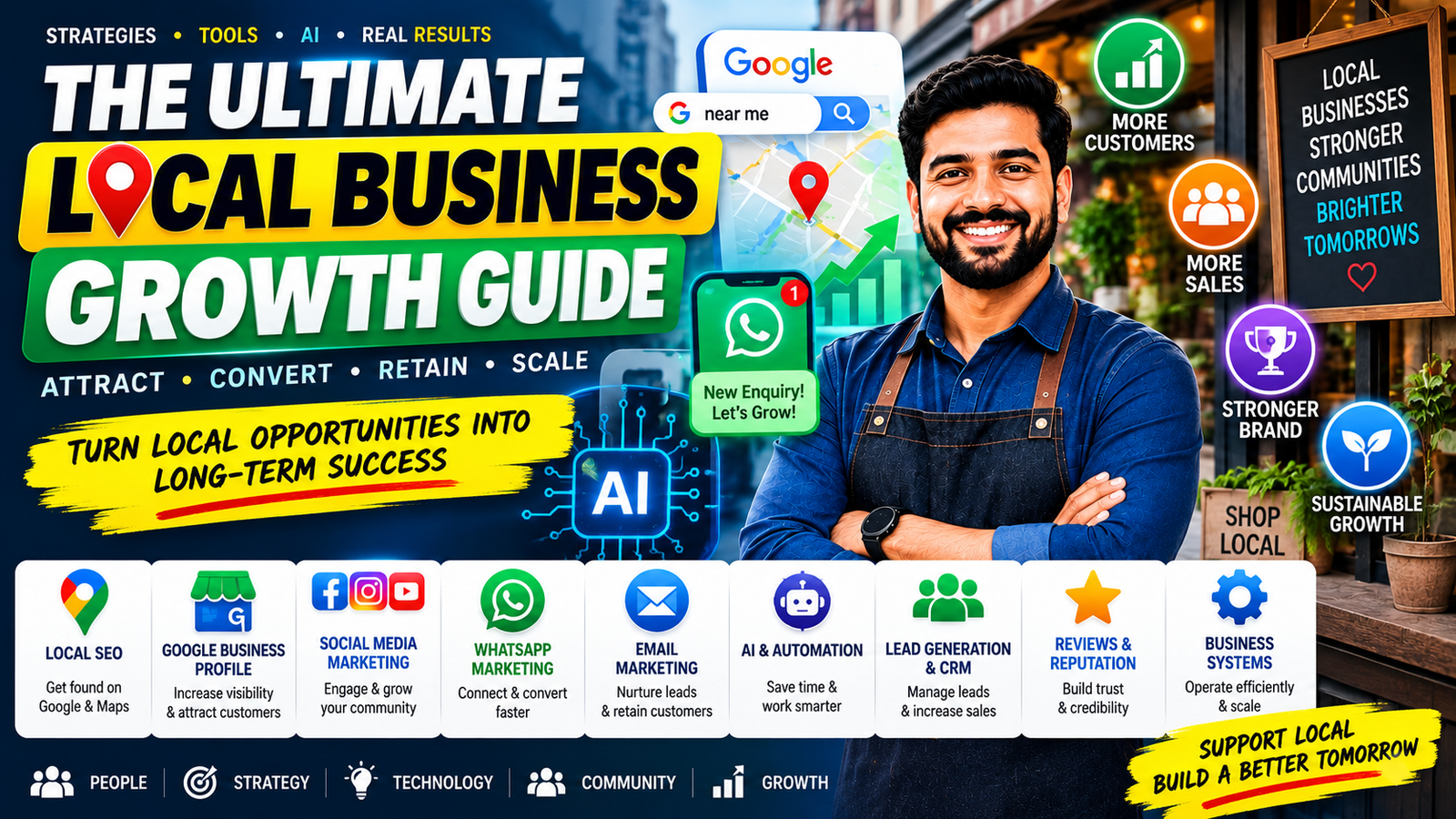
With the right combination of Local SEO, Google Business Profile, digital marketing, social media, customer reviews, WhatsApp, CRM, AI, automation, and excellent customer service, you can create a predictable system for attracting and retaining customers.
This ultimate guide explains how to build that system.
What Is Local Business Growth?
Local business growth is the process of increasing your visibility, customer base, revenue, reputation, and market presence within the locations you serve.
Sustainable growth involves more than getting new customers. A strong strategy should help you:
Get discovered by more local customers
Generate qualified enquiries
Convert more leads into customers
Increase average customer value
Generate repeat business
Improve customer retention
Build a strong online reputation
Generate referrals
Improve profitability
Create scalable business systems
The ultimate objective is to build a business that customers can find, trust, choose, return to, and recommend.
1. Understand Your Ideal Customer
Every successful growth strategy starts with the customer.
Before spending money on advertising or technology, understand exactly whom you want to serve.
Identify your ideal customer's:
Location
Age or customer segment
Needs
Problems
Budget
Buying behavior
Preferred communication channels
Frequently asked questions
Purchase objections
Expectations
Then answer one important question:
Why should customers choose your business instead of a competitor?
Your answer becomes your value proposition.
It could be better quality, faster service, specialized expertise, transparent pricing, convenience, personalized attention, superior support, or a unique customer experience.
2. Optimize Your Google Business Profile
For many local businesses, Google Business Profile is an essential part of online visibility.
Keep your profile complete and accurate with:
Business name
Address
Phone number
Website
Opening hours
Business categories
Products
Services
Photos and videos
Regularly add fresh information and respond professionally to customer reviews.
Your objective is to make it easy for someone discovering your business through Google Search or Maps to understand what you offer and how to contact you.
3. Build a Powerful Local SEO Strategy
Local SEO helps customers discover businesses serving their area.
Examples of local searches include:
“Restaurant near me”
“Best salon in Bangalore”
“Digital marketing company in Bangalore”
“Dental clinic near me”
“Real estate agent near me”
Create useful website pages for the services and locations you genuinely serve.
Optimize:
Page titles
Headings
Meta descriptions
Service pages
Location pages
Internal links
Images
Contact information
Mobile usability
Website performance
Create useful content that answers the questions customers ask before purchasing.
Local SEO is not about repeating keywords everywhere. It is about creating a useful, trustworthy online presence that clearly explains your business and its relevance to local customers.
4. Build a Website That Converts Visitors into Leads
Your website should function as a digital salesperson, not simply an online brochure.
A visitor should quickly understand:
What do you offer?
Who do you serve?
Where do you operate?
Why should they trust you?
What should they do next?
Include clear calls to action such as:
Call Now
WhatsApp Us
Get a Free Quote
Book an Appointment
Request a Consultation
Your website should also include:
Products or services
Testimonials
Customer reviews
Previous work or case studies
FAQs
Contact information
Enquiry forms
Location information
Click-to-call functionality
Make sure the website works well on mobile devices.
5. Build Trust Through Customer Reviews
A strong reputation can become one of your most valuable marketing assets.
Customers frequently use online reviews to compare local businesses before making decisions.
After delivering a successful customer experience, make it easy for customers to leave genuine feedback.
You can request reviews through:
WhatsApp
SMS
Email
QR codes
Receipts
Follow-up messages
Respond professionally to positive and negative reviews.
Never rely on purchased or fake reviews. Authentic customer experiences create sustainable credibility.
6. Create Useful Local Content
Content marketing helps potential customers discover your business and understand your expertise.
Create content around real customer questions.
Useful formats include:
Blog articles
Buying guides
FAQs
Tutorials
Short videos
Case studies
Customer stories
Product demonstrations
Before-and-after examples
Industry insights
For example, a real estate company could publish a guide to buying property in its target area.
A restaurant could create content around popular dishes or local food experiences.
A software company could explain how technology can solve common business problems.
Good content should educate first and sell second.
7. Build a Strong Social Media Presence
Social media gives local businesses an opportunity to stay visible and connected with customers.
You can publish:
Educational tips
Customer testimonials
Short videos and reels
Product demonstrations
Behind-the-scenes content
Team introductions
New products
Special offers
Local events
Business milestones
You do not need to use every social platform.
Focus on the channels where your target customers actually spend their time.
8. Turn WhatsApp into a Business Growth Channel
WhatsApp can support multiple stages of the customer journey.
Businesses can use it for:
New enquiries
Product information
Quotations
Appointment confirmations
Order updates
Customer support
Lead follow-ups
Feedback
Review requests
Relevant promotions
As enquiry volume increases, connect WhatsApp with your CRM or automation system where appropriate.
This can help prevent valuable customer conversations from getting lost.
Always respect customer consent and applicable messaging requirements.
9. Create a Lead Management System
Generating enquiries is not enough.
You need a system for converting them.
Track information such as:
Customer name
Phone number
Email
Service required
Lead source
Estimated opportunity value
Assigned salesperson
Lead status
Follow-up date
Last interaction
Next action
A simple sales pipeline could be:
New Lead → Contacted → Qualified → Proposal Sent → Follow-Up → Negotiation → Won/Lost
A CRM can make this process easier and more consistent.
10. Master the Art of Follow-Up
Many customers are not ready to purchase during their first interaction.
They may be comparing options, waiting for approval, considering their budget, or simply busy.
This makes follow-up extremely important.
Build a structured process using appropriate channels such as phone, WhatsApp, email, or SMS.
Each interaction should add value rather than repeatedly asking:
“Have you decided?”
Instead, provide useful information, answer questions, clarify benefits, or help customers make a decision.
11. Use AI to Grow Your Local Business
Artificial Intelligence gives small businesses access to capabilities that previously required larger teams.
AI can assist with:
Customer support
Lead qualification
Marketing ideas
Content creation
Follow-up drafts
Review responses
Email campaigns
FAQ generation
Appointment assistance
Data analysis
Sales support
The best approach is not to replace people unnecessarily.
Use:
AI for Speed
Automation for Consistency
Humans for Relationships
12. Automate Repetitive Business Processes
Automation can reduce repetitive administrative work.
For example:
Website Enquiry → CRM → Sales Assignment → Follow-Up Reminder
or:
Appointment → Confirmation → Reminder → Service → Feedback → Review Request
or:
Purchase → Thank You → Customer Follow-Up → Relevant Offer → Repeat Purchase
Automating repetitive steps gives employees more time to focus on customer relationships and revenue-generating activities.
13. Run Targeted Digital Advertising
Paid advertising can accelerate local growth when campaigns are properly targeted and measured.
Depending on your business, you may use search, social media, video, or other digital advertising.
Instead of measuring only clicks or impressions, connect campaigns to actual business results:
Advertisement → Lead → Qualified Lead → Customer → Revenue
Track important numbers such as:
Advertising spend
Leads
Cost per lead
Qualified leads
Conversion rate
Customer acquisition cost
Revenue
Return on advertising spend
The goal is profitable customer acquisition—not simply more traffic.
14. Build Referral Programs
Happy customers can become powerful sources of new business.
Create a simple referral system:
Existing Customer → Referral → New Customer → Purchase → Reward
Rewards can include appropriate discounts, credits, loyalty points, complimentary services, or other benefits.
Keep your referral program easy to understand.
Most importantly, provide an experience people genuinely want to recommend.
15. Build Customer Loyalty
Acquiring a customer should be the beginning of the relationship rather than the end.
Customer retention strategies can include:
Loyalty programs
Membership plans
Service reminders
Renewal reminders
Personalized offers
Customer-only benefits
Birthday offers
Educational content
Customer appreciation programs
Ask:
How can we turn a first-time customer into a long-term customer?
16. Build Strategic Local Partnerships
Other local businesses can become valuable growth partners.
Look for complementary businesses serving similar customers.
Examples include:
Real Estate Agent + Home Loan Consultant
Gym + Nutritionist
Hotel + Tour Operator
Wedding Planner + Photographer
Website Development Company + Digital Marketing Agency
Partnerships can involve:
Referrals
Joint events
Bundled services
Cross-promotions
Content collaborations
Community initiatives
A strong local business network can generate opportunities that advertising alone cannot provide.
17. Strengthen Your Brand
A strong brand helps customers remember and trust your business.
Branding includes much more than your logo.
It includes your:
Business name
Visual identity
Website
Social media presence
Marketing materials
Customer communication
Packaging
Employee behavior
Customer experience
Reputation
Consistency builds recognition.
Recognition can build trust.
Trust can influence purchasing decisions.
18. Deliver an Excellent Customer Experience
Marketing can bring a customer to your business once.
Customer experience determines whether they return or recommend you.
Focus on:
Fast responses
Clear communication
Transparent pricing
Reliable service
Professional employees
Easy payment
After-sales support
Complaint resolution
Personalized attention
One excellent customer experience can potentially create repeat purchases, reviews, and referrals.
19. Measure the Numbers That Matter
Business growth should be measurable.
Track KPIs such as:
Website enquiries
Phone calls
WhatsApp enquiries
Leads
Qualified leads
Appointments
Conversion rate
Cost per lead
Customer acquisition cost
Average order value
Repeat customers
Customer retention
Reviews
Referrals
Monthly revenue
Profitability
Marketing ROI
Create a simple monthly dashboard.
Then ask:
Which channels generate our best customers?
Which campaigns generate revenue?
Where are we losing leads?
Which services are most profitable?
How many customers return?
Use these answers to make better decisions.
20. Build Systems Before You Scale
A local business becomes difficult to scale when everything depends on the owner.
Document your important processes.
Create standard operating procedures for:
Marketing
Lead generation
Sales
Follow-up
Customer service
Service delivery
Billing
Complaints
Quality control
Employee responsibilities
Reporting
Once these systems become predictable, you can consider expanding through:
New locations
New products
New services
New cities
Online channels
Partnerships
Franchising
Systemize first. Scale second.
The Ultimate Local Business Growth Funnel
A complete growth system can look like this:
Get Found
↓
Build Trust
↓
Generate Enquiries
↓
Capture Leads
↓
Qualify Leads
↓
Follow Up
↓
Convert Customers
↓
Deliver Excellent Service
↓
Generate Reviews
↓
Retain Customers
↓
Generate Referrals
↓
Automate & Optimize
↓
Scale
This turns individual marketing activities into a connected business growth engine.
A 90-Day Local Business Growth Plan
Days 1–30: Build the Foundation
Focus on:
Google Business Profile
Website improvements
Local SEO
Customer reviews
Lead tracking
Clear offers
Days 31–60: Generate More Opportunities
Introduce:
Content marketing
Social media
WhatsApp
Referral campaigns
Local partnerships
Targeted advertising
Days 61–90: Automate and Optimize
Implement:
CRM
Follow-up automation
AI-assisted customer support
Review automation
Customer retention campaigns
Performance dashboards
At the end of 90 days, review the results and double down on the channels producing profitable customers.
The Ultimate Growth Formula
A simple formula for local business growth is:
Visibility + Trust + Leads + Follow-Up + Conversion + Customer Experience + Retention + Referrals + Systems = Sustainable Growth
Each component matters.
Getting more leads without proper follow-up wastes opportunities.
Getting customers without delivering excellent service damages reputation.
Generating sales without retention forces you to continually spend money finding new customers.
Automation without good processes simply automates poor processes.
The strongest businesses build the entire system.
Final Thoughts
There is no single shortcut to building a successful local business.
Sustainable growth comes from connecting multiple strategies into one customer-focused system.
Make your business easy to discover through Google, Local SEO, your website, social media, and relevant advertising.
Build trust through authentic reviews, useful content, professional branding, and excellent service.
Capture every enquiry, follow up consistently, and use a CRM to manage opportunities.
Then use AI and automation to save time, improve consistency, and scale successful processes.
Finally, focus on retention, loyalty, reviews, referrals, and partnerships so existing customers contribute to future growth.
Remember the ultimate local business growth journey:
Get Found → Build Trust → Generate Leads → Convert → Delight Customers → Retain → Get Recommended → Automate → Scale
When these elements work together consistently, a local business can become a recognized, trusted, and sustainable leader in its market.