How AI Can Help Local Businesses Grow Faster
Discover how AI can help local businesses grow faster by automating customer support, lead generation, follow-ups, marketing, Local SEO, WhatsApp communication, appointments, reviews, and business analytics. Learn pra...
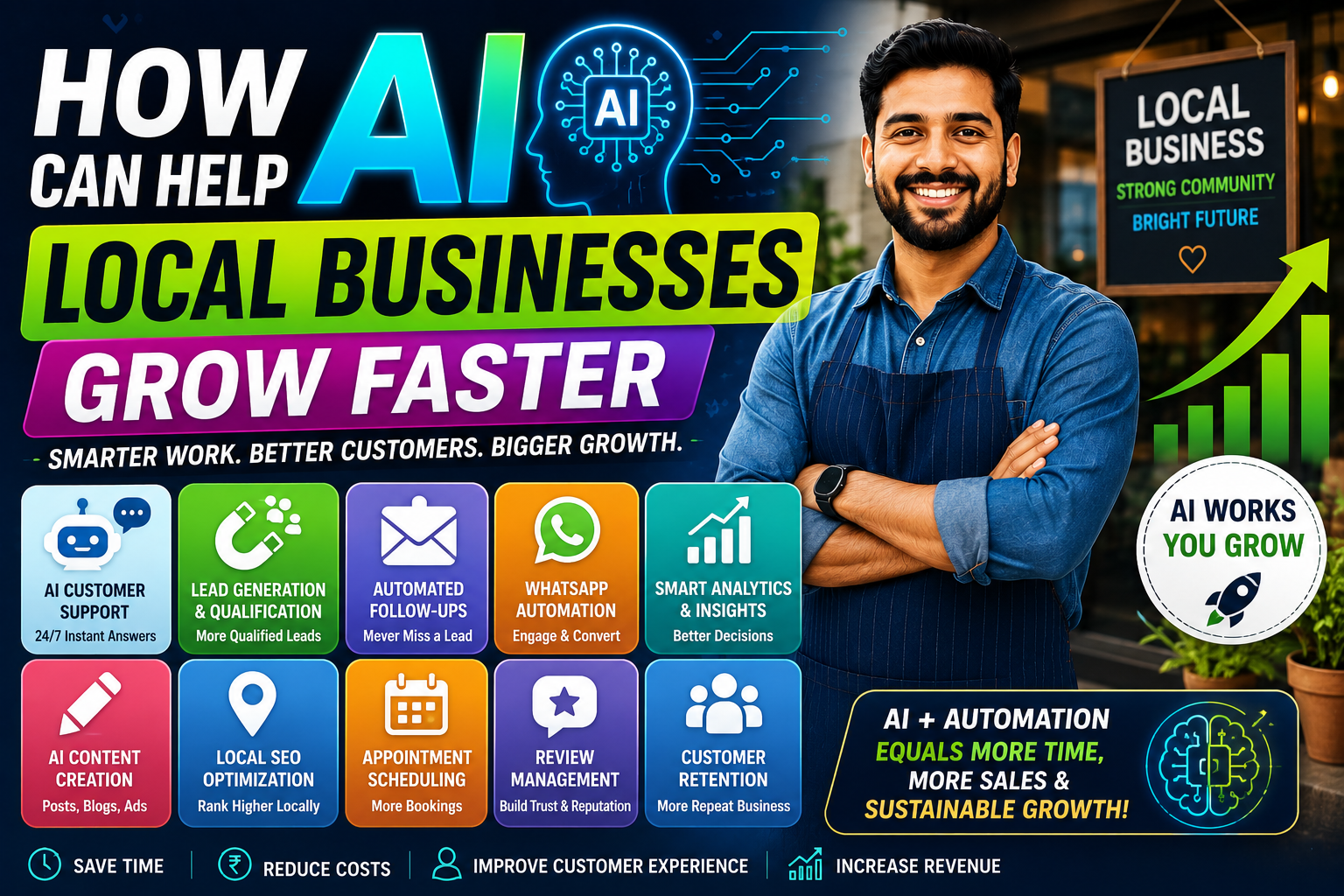
Artificial Intelligence (AI) is no longer technology reserved for large companies. Local businesses can now use AI to attract customers, automate repetitive work, respond to enquiries faster, improve marketing, manage leads, and make better business decisions.
Whether you operate a restaurant, retail store, salon, clinic, real estate agency, hotel, gym, automobile service center, consultancy, or professional service business, AI can help your team accomplish more with less manual work.
The key is not simply adopting AI. It is identifying the right business processes where AI can save time, improve customer experience, or generate more revenue.
Here are some of the most practical ways AI can help local businesses grow faster.
1. AI Can Generate and Qualify Leads
Generating leads is one of the biggest challenges for many local businesses.
AI can support lead generation by helping businesses analyze enquiries, identify potential customers, collect information, and prioritize leads.
For example, an AI-powered website assistant could ask a visitor:
What service are you looking for?
Where are you located?
What is your budget?
When do you need the service?
What is your phone number?
Would you like someone to contact you?
Based on the answers, the system can organize or prioritize the enquiry before sending it to the sales team.
This allows employees to spend more time speaking with relevant prospects instead of manually sorting every enquiry.
2. Provide Faster Customer Support with AI
Customers increasingly expect quick responses.
However, small businesses may not have employees available around the clock.
AI assistants can help answer common questions about:
Products
Services
Pricing
Business hours
Locations
Appointments
Delivery
Returns
Availability
Frequently asked questions
When a question requires human attention, the conversation can be transferred or escalated to an employee.
This combination of AI and human support can improve response times while maintaining personal service where it matters.
3. Automate Lead Follow-Ups
A local business may generate plenty of enquiries but still lose sales because leads are not followed up consistently.
AI and automation can help create structured follow-up workflows.
For example:
New Enquiry → Automatic Confirmation → Sales Assignment → Follow-Up Reminder → Quotation → Follow-Up → Won/Lost
Follow-ups can be coordinated through appropriate channels such as:
WhatsApp
Email
SMS
CRM reminders
Phone-call tasks
AI can also help draft personalized follow-up messages based on the customer's previous enquiry.
This helps sales teams stay organized and reduces the chance of valuable leads being forgotten.
4. Create Marketing Content Faster
Content creation can consume a significant amount of time for small business owners.
AI can help generate ideas and first drafts for:
Blog posts
Social media posts
Instagram captions
Facebook posts
Email campaigns
Product descriptions
Service descriptions
Advertisement copy
Video scripts
FAQs
Promotional messages
For example, a restaurant could generate a month's worth of content ideas around dishes, customer stories, special offers, festivals, and behind-the-scenes content.
A real estate company could generate content around new properties, buying tips, location benefits, financing, and market updates.
Human review remains important. Businesses should check AI-generated content for accuracy, brand voice, relevance, and originality before publishing it.
5. Improve Local SEO with AI
Local SEO helps businesses appear when customers search for products and services in their area.
AI can assist with tasks such as:
Keyword research ideas
Content planning
Service-page drafts
Location-page drafts
FAQ development
Meta-title suggestions
Meta-description suggestions
Content optimization
Internal-linking ideas
For example, a business could build useful content around searches such as:
“Best salon near me”
“Dental clinic in Bangalore”
“Website development company in Bangalore”
“Real estate agency near me”
AI can speed up the research and writing process, but businesses should avoid creating large amounts of low-quality or repetitive content purely for search engines.
Useful, accurate content written for customers should remain the priority.
6. Manage Customer Reviews More Efficiently
Customer reviews play an important role in local business reputation.
AI can help businesses organize and analyze review feedback.
It can identify common themes such as:
Customer service
Product quality
Pricing
Waiting time
Delivery
Staff behavior
Cleanliness
Overall satisfaction
AI can also help draft professional responses to reviews.
For example, positive feedback can receive a personalized thank-you response, while negative feedback can be flagged for management attention.
Review responses should still be checked by a person, especially when dealing with complaints or sensitive situations.
7. Use AI with WhatsApp Marketing
WhatsApp is an important communication channel for many local businesses.
Combined with automation and AI, businesses can manage larger volumes of conversations more efficiently.
Potential applications include:
Answering common enquiries
Capturing leads
Sharing product information
Sending appointment confirmations
Providing order updates
Scheduling follow-ups
Collecting feedback
Requesting reviews
Routing customers to employees
For example, a customer could message:
“I want to book an appointment tomorrow.”
An integrated system could collect the required information and guide the customer toward available booking options.
Businesses should obtain appropriate consent and follow applicable messaging policies when sending promotional communications.
8. AI Can Help Manage Appointments
Appointment-based businesses can use AI and automation to simplify scheduling.
This can be useful for:
Clinics
Salons
Consultants
Real estate agents
Service centers
Fitness trainers
Coaching centers
Professional services
Customers can request appointments through websites, chat, or messaging channels.
Automated workflows can help with:
Appointment Request → Confirmation → Reminder → Appointment → Follow-Up → Feedback
This can reduce administrative work and missed appointments.
9. Personalize Customer Marketing
Customers are more likely to respond to relevant communication than generic promotions.
AI can help businesses segment customers using information such as:
Previous purchases
Service history
Location
Enquiry history
Customer interests
Purchase frequency
Customer value
A restaurant could promote relevant offers to frequent customers.
A service center could send maintenance reminders.
A salon could remind customers about recurring services.
A software company could identify customers approaching subscription renewal.
Personalization should always be handled responsibly, with appropriate customer consent and data protection practices.
10. Improve Sales with AI Assistance
AI can support sales teams throughout the sales process.
For example, AI can help:
Summarize customer enquiries
Prioritize leads
Draft quotations
Prepare follow-up messages
Suggest sales questions
Summarize conversations
Identify stalled opportunities
Generate proposal drafts
Create CRM notes
Instead of replacing salespeople, AI can function as an assistant that reduces administrative work.
Sales employees can then spend more time understanding customers, building relationships, negotiating, and closing deals.
11. Analyze Business Data
Local businesses generate valuable information through sales, enquiries, marketing campaigns, customer interactions, and expenses.
AI can help analyze this information and identify useful patterns.
Business owners could ask questions such as:
Which service generates the most revenue?
Which marketing channel produces the most leads?
Which lead source has the highest conversion rate?
Which customers purchase repeatedly?
Which products are performing poorly?
Which months generate the highest revenue?
Where are we losing leads?
Turning raw business data into useful insights can help owners make better decisions.
12. Automate Repetitive Administrative Work
Small businesses often spend significant time on repetitive administrative activities.
Automation and AI can assist with tasks such as:
Data entry
Customer categorization
Email drafting
Document summaries
Follow-up reminders
Meeting summaries
FAQ responses
Lead assignments
Report preparation
Customer feedback analysis
Even saving a few hours each week can create meaningful value for a small team.
13. Improve Customer Retention
AI is useful not only for acquiring customers but also for retaining them.
Businesses can create automated workflows for:
Renewal reminders
Service reminders
Membership renewals
Birthday greetings
Loyalty rewards
Customer feedback
Re-engagement campaigns
Repeat-purchase reminders
For example:
Purchase → Thank You → Feedback → Review Request → Relevant Offer → Repeat Purchase
This turns individual transactions into longer-term customer relationships.
14. Use AI for Smarter Local Advertising
AI tools can also help businesses plan and optimize advertising.
They can assist with:
Advertisement ideas
Audience research
Headline variations
Campaign copy
Creative concepts
Landing-page content
Performance analysis
Instead of relying only on impressions or clicks, businesses should connect advertising to measurable outcomes such as:
Ad → Lead → Qualified Lead → Customer → Revenue
This makes it easier to understand whether advertising is actually profitable.
15. AI Can Help Small Teams Scale
One of the biggest advantages of AI for local businesses is scalability.
A small team may need to handle marketing, sales, customer support, appointments, reviews, administration, and reporting.
AI can automate or assist with portions of each process.
For example:
Marketing
AI assists with content and campaign ideas.
Sales
AI organizes and prioritizes leads.
Customer Support
AI answers common questions.
Operations
Automation handles reminders and routine workflows.
Management
AI helps analyze reports and performance.
Employees can then focus on work requiring judgment, creativity, expertise, and human relationships.
A Simple AI Growth System for Local Businesses
A practical AI-powered customer journey could look like this:
Customer Discovers Business
↓
Website / Google / Social Media / Advertisement
↓
AI Chat or WhatsApp Enquiry
↓
Lead Captured
↓
AI-Assisted Qualification
↓
CRM
↓
Automatic Follow-Up
↓
Salesperson
↓
Customer Conversion
↓
Customer Support
↓
Feedback & Review
↓
Retention Campaign
↓
Repeat Business & Referral
The goal is to create a connected system rather than using isolated tools that do not communicate with each other.
Where Should a Local Business Start with AI?
Do not automate everything immediately.
Start by identifying your biggest bottleneck.
Ask:
Are we losing enquiries because responses are slow?
Start with customer-support or enquiry automation.
Are salespeople forgetting follow-ups?
Start with CRM and follow-up automation.
Is marketing content taking too much time?
Start with AI-assisted content creation.
Are appointments difficult to manage?
Start with booking automation.
Do we have lots of business data but few useful reports?
Start with AI-assisted analytics.
Solve one meaningful problem, measure the result, and then expand.
AI Should Support Human Relationships
Local businesses often succeed because customers trust the people behind them.
That human connection should not disappear.
AI works best when it handles repetitive and administrative tasks while people handle situations requiring empathy, judgment, negotiation, expertise, and relationship building.
A strong approach is:
AI for Speed + Automation for Consistency + Humans for Relationships
Final Thoughts
AI gives local businesses access to capabilities that were once available mainly to larger organizations.
It can help businesses generate leads, respond faster, automate follow-ups, create marketing content, improve local SEO, manage reviews, organize WhatsApp conversations, schedule appointments, analyze business data, and retain customers.
But technology alone does not create growth.
Successful AI adoption begins with a clear business objective.
Choose the processes where your business is losing time, leads, customers, or revenue. Introduce AI strategically, measure the results, and improve the system over time.
When AI, automation, strong marketing, and excellent customer service work together, local businesses can operate more efficiently, serve more customers, and build sustainable long-term growth.