Local Business Growth: A Complete Guide for Small Businesses
Discover the complete guide to local business growth for small businesses. Learn how to attract more local customers, improve Local SEO, optimize your Google Business Profile, generate reviews, use social media and Wh...
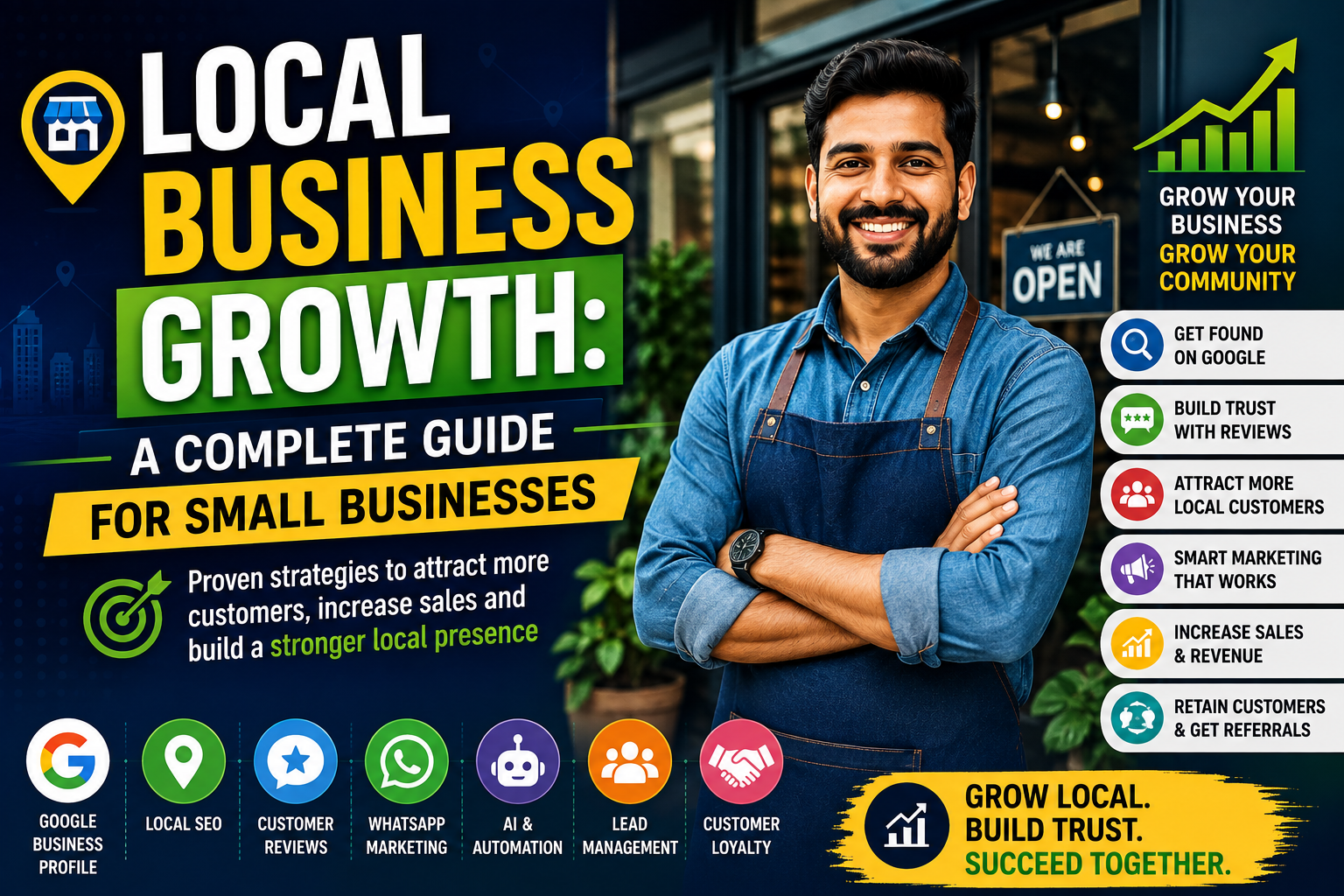
Growing a small local business today requires more than good products, competitive pricing, and excellent customer service. Customers increasingly discover and evaluate businesses through Google Search, Google Maps, websites, online reviews, social media, WhatsApp, and AI-powered tools.
For small businesses, this shift creates a major opportunity.
With the right local business growth strategy, you can increase visibility, attract qualified customers, generate more enquiries, improve conversions, and build long-term customer relationships.
This complete guide explains the key strategies small businesses can use to achieve sustainable local growth.
What Is Local Business Growth?
Local business growth is the process of increasing your business's visibility, customer base, sales, revenue, reputation, and market presence within the geographic areas you serve.
Growth does not simply mean getting more customers.
A healthy local business growth strategy focuses on:
Increasing local visibility
Generating qualified leads
Converting enquiries into customers
Increasing repeat purchases
Improving customer retention
Building a strong reputation
Generating referrals
Increasing customer lifetime value
Improving marketing ROI
Building predictable revenue
The objective is to create a repeatable system that continuously attracts and retains profitable customers.
1. Understand Your Local Customers
Successful marketing begins with understanding exactly who you want to reach.
Identify your ideal customer's:
Location
Age group
Requirements
Problems
Buying behavior
Preferred communication channels
Budget
Frequently asked questions
Reasons for choosing competitors
Reasons for choosing your business
For example, a dental clinic, restaurant, salon, software company, real estate agency, hotel, and automobile service center will each have very different customers.
The better you understand your audience, the easier it becomes to create relevant offers and marketing campaigns.
2. Optimize Your Google Business Profile
Google Business Profile is an important tool for businesses serving local customers.
Complete your profile with accurate information such as:
Business name
Address
Phone number
Website
Business category
Opening hours
Products
Services
Photos
Videos
Keep your information updated whenever something changes.
You should also regularly add photos, respond to reviews, answer questions, and publish relevant business updates.
A strong Google presence makes it easier for customers to discover and contact your business.
3. Build a Strong Local SEO Strategy
Local SEO helps improve your visibility for searches related to your services and geographic market.
Customers might search for:
“Best restaurant near me”
“Web development company in Bangalore”
“Dental clinic near me”
“Real estate agent in Bangalore”
“Car service center near me”
Create dedicated website pages for your important services and locations.
For example:
Service + City
Service + Area
Product + Location
Include relevant local keywords naturally throughout your website without excessive repetition.
Your local SEO strategy can include:
Service pages
Location pages
Local keywords
Internal linking
Business directories
Local citations
Customer reviews
Mobile optimization
Website speed improvements
Structured business information
SEO usually requires consistent effort rather than a one-time setup.
4. Create a Professional Website
Your website should work as a 24/7 sales and information platform.
When someone visits your website, they should quickly understand:
Who are you?
What do you offer?
Where do you operate?
Why should they choose you?
How can they contact you?
Important website elements include:
Clear headline
Products or services
About the business
Customer testimonials
Portfolio or previous work
Business location
Contact information
FAQs
Enquiry forms
WhatsApp button
Click-to-call button
Appointment or booking options
Each important page should contain a clear call to action.
Examples include:
Get a Free Quote
Call Now
WhatsApp Us
Book an Appointment
Request a Consultation
Visit Our Store
5. Build Trust Through Customer Reviews
Reviews are particularly important for local businesses because customers often compare several nearby options before making a decision.
Encourage satisfied customers to leave genuine reviews.
You can request feedback using:
WhatsApp
SMS
Email
QR codes
Receipts
Follow-up messages
Thank-you pages
Respond to both positive and negative reviews professionally.
Never rely on fake or purchased reviews. Authentic customer experiences create stronger long-term credibility.
6. Use Social Media for Local Marketing
Social media helps businesses stay connected with their local communities.
Instead of posting only advertisements, create content that provides value.
Useful content ideas include:
Educational tips
Product demonstrations
Customer stories
Testimonials
Before-and-after results
Behind-the-scenes videos
Staff introductions
New products
Special offers
FAQs
Local events
Short videos and reels
Whenever appropriate, encourage users to call, message, visit your website, or visit your location.
7. Use WhatsApp to Convert More Enquiries
WhatsApp can help local businesses communicate quickly with potential and existing customers.
Businesses can use WhatsApp for:
New enquiries
Product information
Quotations
Appointment confirmations
Order updates
Customer support
Lead follow-ups
Review requests
Offers
Reminders
As your business grows, WhatsApp integration with a CRM or automation platform can help organize conversations and reduce manual follow-up.
Promotional communication should always respect customer consent and applicable messaging requirements.
8. Build a Lead Management System
Generating leads is valuable only when you manage them properly.
Every enquiry should be recorded and tracked.
Useful fields include:
Customer name
Phone number
Email
Lead source
Service required
Estimated value
Assigned employee
Lead status
Follow-up date
Last communication
Next action
A simple sales pipeline could look like:
New Lead → Contacted → Qualified → Proposal → Follow-Up → Negotiation → Won/Lost
A CRM makes it easier to manage this process as lead volume grows.
9. Create a Consistent Follow-Up Strategy
Many customers do not purchase immediately after their first enquiry.
Some are comparing prices.
Others need approval from family members, managers, or business partners.
Some simply forget to respond.
Create a structured follow-up process using appropriate channels such as:
Day 1: Initial response
Day 2–3: Follow-up
Day 5–7: Helpful information or reminder
Later: Relevant offer or final follow-up
The timing should depend on your industry and customer buying cycle.
Avoid excessive messaging. The goal is to be helpful and consistent rather than intrusive.
10. Introduce AI and Business Automation
AI can help small businesses operate more efficiently.
Common applications include:
AI customer support
Lead qualification
Automated responses
Content creation
Social media ideas
Review response assistance
Email drafting
Appointment assistance
Marketing analysis
Follow-up reminders
Automation can connect your website, CRM, WhatsApp, email, forms, appointments, and customer database.
AI should complement your employees rather than eliminate valuable human interaction.
11. Launch Referral and Loyalty Programs
Existing customers can become powerful marketing partners.
Consider introducing:
Referral Programs: Reward customers who introduce new customers.
Loyalty Programs: Reward customers for repeat purchases.
Birthday Offers: Provide personalized discounts or benefits.
VIP Programs: Give frequent customers exclusive advantages.
Membership Plans: Offer recurring benefits for a monthly or annual fee.
Keep the program simple and clearly communicate the benefits.
12. Run Targeted Local Advertising
Paid advertising can accelerate growth when campaigns are properly targeted and measured.
Depending on your business, advertising channels might include search advertising and social media advertising.
Target customers based on factors relevant to your business, such as location, search intent, interests, or previous engagement.
Send advertising traffic to a focused landing page rather than automatically sending everyone to your homepage.
A strong landing page should contain:
Problem → Solution → Benefits → Proof → Offer → Call to Action
Most importantly, track whether advertising produces actual leads and sales.
13. Build Partnerships with Other Local Businesses
Local partnerships can create inexpensive customer acquisition opportunities.
For example:
A gym could partner with a nutritionist.
A wedding photographer could partner with an event planner.
A real estate agency could partner with home-loan consultants.
A web development company could partner with marketing agencies.
A hotel could partner with tour operators.
Look for businesses serving similar customers without directly competing with you.
Partnership opportunities can include referrals, bundled services, events, cross-promotions, and joint marketing campaigns.
14. Retain Existing Customers
Acquiring customers is only one part of business growth.
Encourage satisfied customers to return.
Retention strategies can include:
Excellent customer service
Personalized follow-ups
Loyalty rewards
Maintenance reminders
Renewal reminders
Exclusive offers
Membership programs
Useful educational content
Customer appreciation campaigns
Maintain a customer database so you can identify opportunities for repeat purchases and renewals.
15. Measure Your Local Business Growth
Marketing decisions should increasingly be based on data.
Track KPIs such as:
Website traffic
Calls
WhatsApp enquiries
Leads
Qualified leads
Appointments
Store visits
Conversion rate
Cost per lead
Customer acquisition cost
Average order value
Repeat purchase rate
Customer reviews
Monthly revenue
Marketing ROI
Create a simple monthly dashboard to compare performance.
Ask:
Where are our best customers coming from?
Which campaigns generate sales?
Where are leads being lost?
Which services are most profitable?
How many customers return?
These answers help you decide where to invest your marketing budget.
A Complete Local Business Growth Framework
A practical growth framework looks like this:
Visibility → Trust → Lead Generation → Follow-Up → Conversion → Customer Experience → Retention → Reviews → Referrals → Growth
Visibility
Help customers discover your business through Google, local SEO, social media, advertising, directories, and partnerships.
Trust
Build credibility through a professional website, authentic reviews, useful content, testimonials, and excellent communication.
Lead Generation
Make contacting your business simple through calls, WhatsApp, forms, bookings, and appointments.
Follow-Up
Use a CRM and structured follow-up process so valuable opportunities are not forgotten.
Conversion
Improve sales conversations, proposals, pricing, offers, and customer experience.
Retention
Encourage customers to purchase again through excellent service and relevant communication.
Reviews and Referrals
Satisfied customers can strengthen your reputation and introduce your business to new customers.
Final Thoughts
Sustainable local business growth does not usually come from one marketing trick.
It comes from building a complete system.
Start by improving your Google presence, website, local SEO, customer reviews, and social media.
Then strengthen your lead management, WhatsApp communication, follow-up process, customer retention, referrals, and local partnerships.
As your business grows, introduce AI, CRM, and automation to make these processes more efficient.
The goal is simple:
Get discovered. Build trust. Generate enquiries. Convert customers. Deliver excellent service. Encourage repeat business. Generate reviews and referrals.
When these activities work together consistently, your small business can build stronger local visibility, attract more customers, increase revenue, and create sustainable long-term growth.